As ambassadors of the rich and colourful marine life found in our tropical waters, two of the most well-known species of sea turtles endemic to Malaysian waters are on the new RM20 banknote - the Hawksbill Turtle (Eretmochelys imbricata) and Leatherback Turtle (Dermochelys coriacea).
Showing posts with label turtle. Show all posts
Dec 23, 2011
Sea Turtles on Malaysian Bank Notes
From the website of Central Bank of Malaysia
Jul 23, 2011
JTP Turtle Talk (4)
Part 1
Part 2
Part 3
Meet Jo, a 5 year old green sea turtle that we take care of. Jo was born in our hatchery in 2006. When we went to release her in the sea with her other brothers and sisters, she was found running in circles on the sand because of a weak arm. That's when we realized that something is wrong with her and a close inspection also revealed that she has no eyes. She was born this way probably due to some kind of genetic or developmental anomaly from mistreatment of the egg while transfering from the original nest. A turtle without eyes will not survive in the ocean or on land. This is just natures way of making sure that only the fittest individuals survive. So by keeping her in our sanctuary we are not tampering with the natural course here.
Part 2
Part 3
Meet Jo, a 5 year old green sea turtle that we take care of. Jo was born in our hatchery in 2006. When we went to release her in the sea with her other brothers and sisters, she was found running in circles on the sand because of a weak arm. That's when we realized that something is wrong with her and a close inspection also revealed that she has no eyes. She was born this way probably due to some kind of genetic or developmental anomaly from mistreatment of the egg while transfering from the original nest. A turtle without eyes will not survive in the ocean or on land. This is just natures way of making sure that only the fittest individuals survive. So by keeping her in our sanctuary we are not tampering with the natural course here.
JTP Turtle Talk (3)
Part 1
Part 2
The way we try to protect turtle eggs is by bringing them to an enclosed hatchery until the baby turtles hatch. This is not ideal, it is much better to leave the eggs in place where they were laid, but that is not possible here now. Still a hatchery should always be viewed as a temporary feature, not a solution. It is better to have the entire area protected and not need to take, or hide, the eggs.
Part 2
The way we try to protect turtle eggs is by bringing them to an enclosed hatchery until the baby turtles hatch. This is not ideal, it is much better to leave the eggs in place where they were laid, but that is not possible here now. Still a hatchery should always be viewed as a temporary feature, not a solution. It is better to have the entire area protected and not need to take, or hide, the eggs.
Jul 22, 2011
JTP Turtle Talk (2)
Part 1
So what do we do at JTP ? We focus on sustaining the turtle population, habitat defence and raising awareness. This brings us to understand and work with the nature, people, economy and politics of this island. We are not hippies or treehuggers, we are working toward a specific goal here. We work toward not having to run a conservation effort like this because people will be conscious and protective of nature around them and wild life in the area including sea turtles.
JTP Turtle Talk (1)
I volunteered in the Juara Turtle Project for a month in June 2011. Every morning and evening we would give a 45 minutes long 'Turtle Talk' to interested tourists, followed by a tour of the hatchery and a chance to meet Jo - the blind Gree turtle that JTP have been taking care of since 2006.
Jul 17, 2011
Map of Mentawak Beach
Juara Turtle Project is a sea turtle conservation effort at the Juara village of Tioman island in Malaysia. Currently they are monitoring three beaches on the east coast of Tioman. Depending on tide schedule, the conservationists at JTP take turns patrolling the Mentawak beach every night.
I surveyed the Mentawak beach while volunteering at JTP for a month. This map of Pasir Mentawak(Mentawak Beach) is based on the GIS data collected through out June 2011. High-tide line, low-tide line, vegetation line along with some important geographic features and landmarks are shown on this map. A Garmin Etrex
GPS receiver was used for data collection. These low cost GPS receivers being sand and water resistant are ideal for the job IMHO. An open source graphics editor, Inkscape was used to plot the map. The image posted in this blog entry is a low resolution bitmap. Vector version in Scalable Vector Graphics (SVG) format or a PDF file is available upon request.
I surveyed the Mentawak beach while volunteering at JTP for a month. This map of Pasir Mentawak(Mentawak Beach) is based on the GIS data collected through out June 2011. High-tide line, low-tide line, vegetation line along with some important geographic features and landmarks are shown on this map. A Garmin Etrex
Jul 12, 2011
Plants can damage sea turtle eggs too
Any sea turtle conservationist in charge of a hatchery should watch out for animals that can dig. Dogs, crabs, lizards, rats, snakes etc. animals are natural threat to eggs in any sea turtle nest on the beach and they will gladly play the same role against secondary nests that have been set up in a hatchery. Although it sounds incredible, trees can also damage the eggs by growing roots around or into the eggs.


In a recent excavation of a secondary nest in Juara Turtle Project, some eggs were found damaged in this way. While some of the eggs were completely entangled with the roots growing all around, others were found damaged by the roots breaking the shell and growing into the egg.


In a recent excavation of a secondary nest in Juara Turtle Project, some eggs were found damaged in this way. While some of the eggs were completely entangled with the roots growing all around, others were found damaged by the roots breaking the shell and growing into the egg.
Mar 13, 2011
Stranded turtles on Teknaf beach
Mar 7, 2011
Automatic Species ID : Lepidochelys olivacea

The automatic species ID procedure I'm working on, follows these steps of image manipulation and decision making to detect Lepidochelys olivacea from a photo. For demonstration I'm using an image contributed by M.A. Hannan.
1. Convert RGB image to Lab color space
2. Enhance 'b' channel of the image

3. Complement 'b' channel of the image

4. Threshold complemented 'b' channel of the image with a predefined constant, 210 for this image

5. Dilate the resulting image

6. Fill the resulting image

7. Erode the resulting image

8. Mark the blob with maximum area

9. If area of the marked blob is not less than 30% of the image size then declare detection of LO
Feb 28, 2011
Automatic Species ID : Chelonia mydas

The automatic species ID procedure I'm working on goes through the following steps of image manipulation and decision making to detect Chelonia mydas from a photo. For demonstration I'm using an image contributed by Rachel Ruzgis to the image database of www.seaturtle.org
1. Convert RGB image to Lab color space

2. Threshold 'a' channel of the image with a predefined constant, 100 for this image

3. Fill holes

4. Erode image
5. Mark the blob with maximum area

6. If area of the marked blob is not less than 20% of the image size then declare detection of CM
Nov 27, 2010
Planner graph on Kemp Ridley and Olive Ridley turtles' carapace

Kemp's Ridley or Lepidochelys kempii is the smallest of all sea turtle species. Reaching maturity at 2–3 feet (61–91 cm) long and averaging only 45 kilogram. It's carapace contains five vertebral scutes running down the midline, while five pairs of costal scutes border them. The resulting planar graph due to this scalation is 3-regular 28 vertices and 42 edges. Exactly same as as that of Loggerhead or Caretta Caretta.

Olive Ridley or Lepidochelys olivacea is also one of the smallest turtle species. its heart-shaped carapace is characterized by four pairs of pore-bearing inframarginal scutes on the bridge, two pairs of prefrontals, and up to nine lateral scutes per side. Scalation can be asymmetrical i.e. 6 lateral scutes on one side and 8 on the other.
Nov 19, 2010
Planner graph on Loggerhead Turtle's carapace
Nov 1, 2010
Sea turtle carapace pattern as criterion for automatic species ID
The pattern seen on the carapace of sea turtles is one of the criterion used for identifying species, why not try to use this for automatic species ID as well ? The advantages of using this approach for automatic ID would be
- Works for photos taken in wide range of environments and lighting condition varying from the animal's natural habitat (under water) to decaying carcass of stranded animals found on beaches
- Only the carapace needs to be observed; other body parts, which decay sooner than the carapace in a dead animal, don't need to be observed
- Can work for both color and bw photographs
- Possibility of successful detection from broken or incomplete carapace if the key parts of the carapace is found
- Feature Extraction
The sought after feature here is the pattern on the carapace. To understand the challenges in extracting this feature, we should understand its origin first. What we are referring to as pattern in common English as 'Pattern' is actually the network of ridge lines between scutes on the turtles carapace. This is true for all the species of Cheloniida family. For Dermochelys coriacea or leatherback turtle, the only species of Dermochelyidae family, the pattern is originated by the seven ridge lines on its back. Experimentation with several photograph taken in varying environment reveals that the ridge lines are best visible, hence extractable, in case of underwater photos.
The above image shows the result of gradient magnitude, a standard edge detection algorithm, applied on a photograph followed by edge thinning on the resulting gradient magnitude image. But this does not yield good extractable features from photographs of stranded animals found on beaches, specially the decaying ones. Worse, due to presence of debris or other objects inside the frame, wrong part of the image is extracted instead of the carapace by the gradient magnitude finding operation.
- Graph reconstruction
The next challenge encountered is reconstruction of the pattern extracted from the photograph. Ideally, this would be the complete network of ridge lines. But the resulting image after feature extraction does not always have a complete network traced in most of the real life situations. So the graph reconstruction procedure should be robust enough to reconstruct a graph from incomplete or broken edges and at the same time be able to identify and discard edges that are not from the ridge lines on the turtles back.
Graph on sea turtle carapace
Sea turtles belong to the superfamily Chelonioidea and inhabit all of the world's oceans except the Arctic. There are seven species of sea turtles.
Family Cheloniida
Chelonia mydas or green turtle
Eretmochelys imbricata or hawksbill turtle
Natator depressus or flatback Turtle
Caretta caretta or Loggerhead Sea Turtle
Lepidochelys kempii or Kemp's Ridley turtle
Lepidochelys olivacea or Olive Ridley turtle
Family Dermochelyidae
Dermochelys coriacea or leatherback turtle

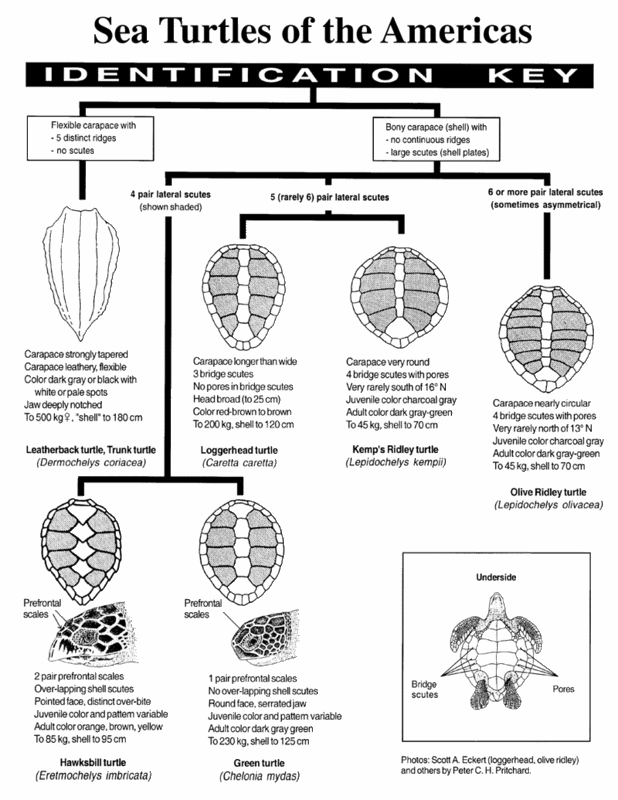
The above Image shows how to identify species of a sea turtle based on its carapace or the back. Anyone with idea of Graph theory would immediately recognize the graphs drawn on the carapace of different turtle species. I believe this is a good criterion for automated species identification from sea turtle photographs.
Family Cheloniida
Chelonia mydas or green turtle
Eretmochelys imbricata or hawksbill turtle
Natator depressus or flatback Turtle
Caretta caretta or Loggerhead Sea Turtle
Lepidochelys kempii or Kemp's Ridley turtle
Lepidochelys olivacea or Olive Ridley turtle
Family Dermochelyidae
Dermochelys coriacea or leatherback turtle
The above Image shows how to identify species of a sea turtle based on its carapace or the back. Anyone with idea of Graph theory would immediately recognize the graphs drawn on the carapace of different turtle species. I believe this is a good criterion for automated species identification from sea turtle photographs.
Oct 29, 2010
Updates on Sea Turtle Species ID


Had considerable progress in this month on my ongoing research work, the sea turtle species identification project. Can detect two sea turtle species now among the seven species of sea turtles. Here are test results for two pictures of sea turtle carcasses found washed up on coast of Bangladesh. the one on top is Lepidochelys olivacea(LO) a.k.a Olive Ridley and the one bellow is Chelonia mydas(CM) a.k.a Green turtle. The white line around the subject and the name of species in black letters inside the black box at top-left corner are output produced by my program.
Click the links for more on species ID of Olive Ridley and Green turtles.
Image courtesy : M.A. Hannan
Subscribe to:
Posts (Atom)